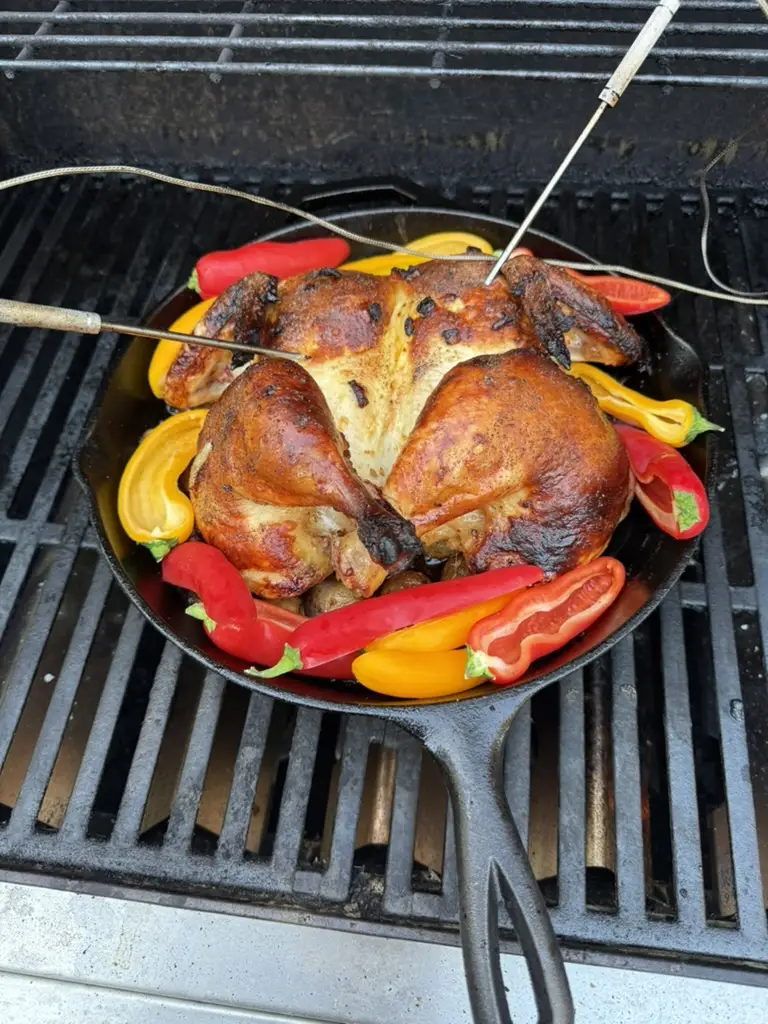
Monday night I butterflied a 4 lb chicken, buried it in preserved lemons and sliced red chilis overnight, laid it skin up on a 12" Lodge full of halved potatoes, and slid the whole thing onto the Weber Genesis over the unlit center burner at 425°F. Fifty minutes later I pulled it at 155°F in the breast and we ate the juiciest bird I have cooked all summer. The preserved lemon had gone into the meat itself, salty and floral and a little funky, with the chili heat arriving late and low. The boys went back for thirds.
The skin was not crisp. The potatoes were soft and a little greasy. And I spent the rest of the night quietly relitigating the cook in my head.
My first theory was the foil. I tented the bird while the potatoes finished, and foil traps steam, and steam is the enemy of crisp. Tidy story. Mostly wrong.
the actual culprit was the cutting board
Here is the thing nobody tells you about resting a chicken. A four pound bird throws off a shocking volume of fat and juice as it rests, and if it is sitting on a flat board, that liquid has nowhere to go. It pools. The bird sits in the pool. Skin that came off the grill perfectly rendered goes soft in about five minutes, from underneath, while you stand there congratulating yourself.
Look at the board in any of these photos and you can see the puddle. That is fifteen minutes of slow sabotage.
The fix costs nothing. Rest poultry on a wire rack set over a sheet pan. Air underneath, fat drains away, skin stays where you left it. I have known this for roast chicken in the oven for years and somehow never carried it over to the grill, because the grill feels like a different sport. It is not.
the second culprit was the skillet itself
That pale, thick, slightly translucent band along the bottom edge is not a resting problem. That is fat that never rendered. And it was never going to, because that part of the bird spent 50 minutes inside a cast iron wall with a pound and a half of raw potatoes steaming underneath it.
The top of the chicken got dry radiant heat and came out the color of an old penny. The sides sat in a humid pocket at roughly the temperature of boiling water and stayed the color of raw dough. Same bird, same cook, two completely different results, separated by about two inches of skillet.
crisping is just evaporation with better marketing
Which brings me to the potatoes, and to the part that actually reframed this for me.
Browning cannot start until the surface water is gone. That is the whole game. Everything we call crisping is really just water leaving, and anything that slows water down slows browning down with it.
I tossed those potatoes in beef tallow before they went in. Then a four pound chicken rendered its own fat into the same pan for the better part of an hour. So they finished sitting in a shallow pool of fat that, because all that moisture was evaporating and cooling the pan, was running well below the temperature on the dome gauge. Fat plus moderate heat plus time does not equal crisp. It equals confit. Delicious, and not what I was going for.
Three fixes, in order of how much they matter. Pour the excess fat off before the final blast, into a jar, because that is schmaltz and it is a gift. Skip the added tallow entirely next time, since the chicken brings plenty. And give the crisping blast 10 to 12 minutes over a live burner, not the 5 I gave it, undisturbed for the first half.
the trade you are actually making
Here is what I did not want to admit while I was eating a really good dinner. The one pan version is not a technique I executed badly. It is a trade, and it is a fair one.
Put the bird on the potatoes and you get everything that falls out of that chicken soaking into everything below it. That is real flavor and you cannot fake it. What you give up is the dry air that the lower half of the bird needs, and the evaporation the potatoes need. You cannot have both in the same two inches of space.
So next time the bird goes on the warming rack and the skillet goes on the grate directly underneath. Drippings still fall. Air still circulates. Nobody has to lose. I wrote it up that way in the full recipe, rack and all, along with the preserved lemon marinade and the relish you make from the bits you scrape off the skin.
The grill is where I get most of my good ideas and most of my honest feedback, usually in the same night. Last time it was feeding a sleepover. This time it was a cutting board full of chicken fat telling me exactly what I had done wrong.
So what is your move for crisp skin off a gas grill, and does anybody actually get there without finishing over direct flame?